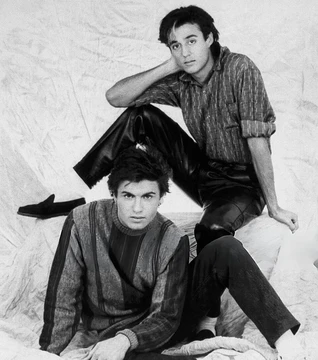
Alma Kaminiito
A Japanese-Peruvian duo blending J-pop and Latin pop.

Noticias Nippon · CC BY 3.0
Alma Kaminiito (アルマカミニイト) was a J-pop and Latin pop music duo based in Japan, consisting of Eric Fukusaki of Peru and Munehiko Ohno from Japan. Active from 2011 to 2013, the duo released two singles and a cover album, aiming to unite Japan with the world through a blend of J-pop and Latin pop.
- formed
- 2011
- disbanded
- 2013
- genre
- J-pop, Latin pop
- members
- Eric Fukusaki, Munehiko Ohno
- label
- Up-Front Works
- notable_releases
- "Akane" (2012), "Amatsubu Pearl"/"Dakishimetai Dakishimetai" (2012), Alma Covers (2012)
Lore & Background
Alma Kaminiito formed in 2011 after Eric Fukusaki and Munehiko Ohno separately auditioned for Up-Front Works' Forrest Award. Fukusaki, part of the Japanese diaspora in Peru, had moved to Japan at age 18 to pursue enka, while Ohno, a Japanese native, practiced buyō dance and took singing lessons in university. The record company proposed they form a duo; Ohno agreed immediately, while Fukusaki deliberated for two weeks after consulting Alberto Shiroma and Kazufumi Miyazawa. The duo's name was created by staff combining Spanish words 'alma' (soul) and 'caminito' (little path), with the spelling altered to 'Kaminiito'.
Reader's Guide
Alma Kaminiito's significance lies in its brief but intentional fusion of Japanese and Latin American musical cultures, embodied by its Peruvian-Japanese lineup and Spanish-language covers of Japanese songs. The duo's debut single "Akane" was used in the film Share House (2011), and its cover album Alma Covers featured Japanese songs from the 1980s and 1990s sung in Spanish and English, with lyrics translated by Fukusaki. The group disbanded in April 2013 after Ohno left to take over his family's business, marking the end of a short-lived but culturally bridging project. Their legacy is as a niche example of cross-cultural collaboration in early 2010s Japanese pop music.
Did You Know?
- The duo's name combines Spanish words 'alma' (soul) and 'caminito' (little path), with the latter respelled as 'Kaminiito'.
- Ohno decided to join the duo on the day of his successful audition; Fukusaki took two weeks to decide.
- The duo's debut single 'Akane' was released in 2012.
Formation & Cross-Cultural Origins
Alma Kaminiito emerged from two very different artistic journeys converging at a single record-label audition. Eric Fukusaki, born into the Japanese diaspora community in Peru, left his home country at eighteen to pursue a career in enka music in Japan. Munehiko Ohno, a native Japanese artist, had spent his life immersed in buyō, the traditional Japanese dance form, before the music duo Chemistry sparked his interest in singing at the same age. He pursued vocal training while studying at university. In February 2011, both men independently auditioned for Up-Front Works' Forrest Award competition. The label, recognizing complementary talents, proposed they form a joint act. Ohno accepted on the spot; Fukusaki, after consulting Alberto Shiroma of Diamantes and Kazufumi Miyazawa of The Boom, took two weeks to decide. The duo's name was crafted by staff selecting Spanish words—"alma" for soul and "caminito" for path—before the company president reinterpreted the latter as "kami ni ito," evoking paper and thread. Their stated mission was to blend J-pop with Latin pop and unite Japan with the wider world.
Discography & Lyrical Craft
The duo's recorded output was compact but distinctive. Their debut single "Akane," a reggae-inflected track, dropped on April 25, 2012. Notably, the three songs recorded for that release had already found a home in the 2011 drama film Share House before the single hit shelves. In October of the same year, they followed with a double A-side pairing "Amatsubu Pearl" with "Dakishimetai Dakishimetai." The year closed with Alma Covers, a full-length album that reimagined Japanese-language songs from the 1980s and 1990s through Spanish and English vocals. Fukusaki personally penned the translated Spanish lyrics, a task that underscored his bilingual fluency and the project's cross-cultural ambition. This cover album would ultimately serve as the unit's final release, as Ohno's departure in early 2013 brought the collaboration to a close. Across just two singles and one album, Alma Kaminiito carved out a niche at the intersection of J-pop sensibility and Latin musical phrasing, a sound that remained rare in the Japanese market.
Live Performances & Public Appearances
Before any record was officially released, Alma Kaminiito built a following through street performances and guest slots at various music events across Japan. The duo's public debut push came on April 25, 2012, when they performed at the Sunshine City building complex in the Ikebukuro district to promote "Akane." That summer, they staged their first dedicated concert, billed as Alma Kaminiito 1st Live "Uno," in August 2012. The Spanish title reflected both the milestone of their first show and the duo's bilingual identity. Following the release of Alma Covers in December, the pair launched their first touring run, which stretched from the end of 2012 into February 2013. These live engagements gave audiences a chance to experience the blend of J-pop and Latin pop in a setting where the energy of Fukusaki's Peruvian roots and Ohno's Japanese dance background could be felt in the performance itself. The tour represented the duo's most extended period on stage before the group's eventual dissolution.
Dissolution & Final Chapter
On April 4, 2013, Alma Kaminiito's official website carried the announcement that Munehiko Ohno was leaving the group. In a personal blog post, Ohno explained that his decision stemmed from a desire to take over his family's business, a practical step that ended the duo's creative partnership. The departure effectively concluded the unit's brief but focused run. Looking back, the duo's entire discography spanned roughly a year: two singles and one cover album, all released in 2012. Their story—two artists from vastly different cultural backgrounds, one a Peruvian-Japanese enka aspirant and the other a Japanese buyō dancer turned singer—had been a genuine experiment in cross-cultural collaboration within the Up-Front Works roster. The name they carried, blending Spanish and Japanese etymologies, encapsulated the ambition that drove their short career: to find a shared thread between Japan and the wider world, even if that thread lasted only a single year of recordings and performances.
Gallery

Frequently Asked Questions
Who is Alma Kaminiito?
Alma Kaminiito (アルマカミニイト) was a short-lived pop duo pairing Eric Fukusaki, a Peruvian artist, with Munehiko Ohno from Japan. They operated under the Up-Front Works label and were active from 2011 until their breakup in 2013.
What genre does Alma Kaminiito perform?
The duo built their sound around a fusion of J-pop and Latin pop, deliberately mixing Japanese pop sensibilities with the rhythmic and melodic flavors of Latin music. Their stated goal was to use that cross-genre blend as a bridge between Japan and the wider world.
What are Alma Kaminiito's notable releases?
Their discography is compact: the 2012 single "Akane," the 2012 double-A-side "Amatsubu Pearl" / "Dakishimetai Dakishimetai," and a 2012 cover album titled Alma Covers. All three projects came out within the same year, reflecting the duo's brief but concentrated output.
When did Alma Kaminiito form and when did they disband?
The group was put together in 2011 and went their separate ways in 2013, meaning they had roughly two years of public activity. Their entire catalog of singles and the cover album was released during that narrow 2012 window.
Why is Alma Kaminiito considered notable in the pop-duo space?
Their significance lies in being a genuinely cross-cultural pairing—Peruvian and Japanese—rather than a purely domestic act, which gave their J-pop/Latin-pop fusion an authentic bilingual flavor. In a market where most duos stay within one national scene, Alma Kaminiito's identity as a bridge between Peru and Japan made them a distinctive, if short-lived, experiment.
More in Pop music duos 1-24
Spotted an error? Know more?
This is a living reference — every entry is fact-audited, and reader corrections feed straight into our audit queue. Suggest an edit · See this site's audit record